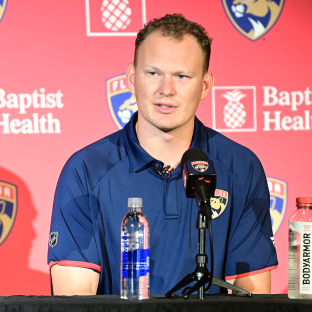
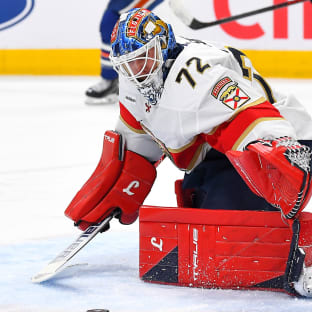
Bill Ranford with Hampton Slukynsky LAK

It all started with a joke.

Then-Boston University goalie coach Brian Daccord was working with his top goalie, New Jersey Devils draft pick Mikhail Yegorov, when he made a crack about King Kong in the direction of the 6-foot-5 behemoth.

 It landed.

"He responded and his chest got big and his body got big," said Daccord, now the director of goaltending and scouting development for the Detroit Red Wings. "I'm like, OK, let's go with the King Kong thing."

That reaction explains why, on a day last spring, hours before a Hockey East semifinal that BU would lose to the University of Connecticut, Daccord spent time putting together a one-minute highlight reel of Yegorov's best saves from the previous game.

When he sent it to Yegorov, the thumbnail of the video was a picture of King Kong.

"That's what performance coaching is," said Daccord, who has also worked in goalie coaching and consulting for the Boston Bruins, Toronto Maple Leafs and Arizona Coyotes, and runs Stop It Goaltending. "You've got to handle every goalie different. Everybody's different. Everybody learns differently, everybody performs differently, everybody has a different mindset. And so it's understanding how to influence, right?"

While another goalie might have laughed off the King Kong comment, thinking it stupid or juvenile, for Yegorov, it worked. And therein lies the magic and the psychology and the game-planning and teaching and ethos of being a goalie coach.

The goalie position has been transformed over the past 30-plus years, and the rise of goalie coaches both parallels and helps to explain that evolution. As skaters have become increasingly skillful, goalies have raised their game to match, turning a position that was once built on instinct and reflexes into one of preparation, analysis, and repetition. Goalie coaches have gone from part-time pals of their goalies to heads of increasingly intricate departments with extensive staffs all dedicated to one thing: stopping the puck. 

It has changed everything.

"I think it's day and night," Daccord said. "Like if you had the kids watch the old goalies from 20, 30 years ago, they laugh. Because the efficiency is not there, the economy of motion is not there, the understanding of probability and expectancy is not there."

Being a goalie coach is a job that is both isolating and essential, the coach playing the role of teacher, analyst, confidante and psychiatrist to players who face incredible pressure and shoulder great responsibility, but who exist in a world apart from the other skaters and the head coach.

"Coaches don't necessarily understand the position or what goalies are going through. All they really see is whether the puck goes in or not," said Calgary Flames goalie coach Jason LaBarbera. "As a goalie coach and as a goalie, you certainly know there's more to it than just a puck going in."

* * * *

When many of the current goalie coaches were coming up -- at least those in the NHL -- goalie coaches were little more than a suggestion, a ghost of a presence who would come through town occasionally, lend a bit of advice, and be off.

It was a part-time role, at best.

"They'd just kind of pop in," said Bob Essensa, who played 446 games in the NHL over 12 seasons with five teams and who has been the goalie coach for the Bruins for the past 23 seasons. "Usually when the pucks were getting smaller all of a sudden they'd show up. Go figure."

There was little structure, little organization to the position, with the goalies often left to their own devices, left to teach themselves, with only their goalie partners for support. It made for goalies playing radically different styles, without uniformity or trends.

Bob Essensa BOS goalie coach explains a drill

Bob Essensa, the goalie coach for the Boston Bruins, said there were times when the goalie coach would 'just pop in,' before it became a full-time job.

And then, in 1984, the Montreal Canadiens hired Francois Allaire.

It was a hiring that would eventually change the way both the position, and the coaching of the position, was thought about. No longer would goalie coaches just "give the goalies somebody to talk to," as Mitch Korn put the job description of his predecessor when he was hired by the Buffalo Sabres in 1990. 

They would teach. They would strategize. They would offer what every other player on the team already had: a guide. 

But because there was no precedent, so many of those early goalie coaches learned on the job, manifesting a profession that hadn't exactly existed before. They hadn't had goalie coaches. They hadn't been goalie coaches.

"When I came out after playing, I thought, oh man, I'll just become a goalie coach and it'll be no problem," said Bill Ranford, the director of goaltending for the Los Angeles Kings, who served as the team's goalie coach for 17 seasons before moving to his current position, and who was 13 years into his own NHL career before he got a full-time coach. "I really had a lot to learn. It was a real trial by error. There was no handbook given to me when I joined the Kings."

There were moments, for Ranford, when it started to click: when he rebuilt Ben Scrivens, a goalie unlike any he had ever worked with, stripping down parts of his game and starting from scratch; when he took Darcy Kuemper from a player who was "a little bit down and out and broken" mentally, not sure where his career was going back in 2017-18, helping him become the goalie who would lift the Stanley Cup in 2022 with the Colorado Avalanche.

"That's when I kind of started to realize I'm starting to figure the position out," Ranford said.

He wasn't the only one. Across the NHL, goalie coaches became standard, then mandatory, then simply one man in a larger department dedicated to the position. When the Washington Capitals won the Stanley Cup in 2017-18, it was in Korn's first season as the full-time director of goaltending after still only being with the team about 18-20 days a month the season before. 

Other teams paid attention. 

Goalie coaches, once isolated and shunted to the side, became part of the team. Part of everything. Every day, providing input not just for goalies, but also scouting and consulting, skating extra players, giving pre-scout input on how to attack the opponent's goalie.

"In 25 years, it's unbelievable how much that's come around," said Daccord, the father of Seattle Kraken goalie Joey Daccord. "When I was the goalie coach for the Boston Bruins (in 2000), it was a one-man show. I was the entire goalie department. When I was the director in Arizona (in 2020-21), I was the goaltending director, I had a goalie coach in the NHL, I had a goalie coach in the AHL, I had a goalie coach in the East Coast League. I had a North American goalie scout and I had a European goalie scout.

"Totally, totally different."

* * * *

When Korn breaks down the job he has done for the past three and a half decades, he comes up with three categories: the physical skills, the mental skills, and the emotional skills.

"And as a goalie coach, we have absolutely the most impact on the physical skills," he said, noting the need for goalie coaches to have a strong teaching background. "We can correct the foot, the smallest little thing, most of our work is physical. The difference between goalie No. 1 and goalie No. 64 physically in the NHL is miniscule. One's a little bigger, one's a little smaller, one catches a little better, one's a little faster, one's better on breakaways."

But those smallest of differences can alter everything.

The change in physical skills since the advent of modern goalie coaches has been tremendous, turning players who were little more than puck stoppers into fonts of information about positioning and angles, mechanics and technique.

It has all been revolutionized, analyzed down to the smallest detail.

"I think our goalies are tremendously well trained, to the point where it's almost gone to the other end of the spectrum or the pendulum, where there is so much instruction and now we actually spend more time balancing that off with what I call skill application and skill aptitude," Daccord said.

It has turned a position once focused purely on instinct, on reaction, into one of science and training.

It's been necessary as skaters have become ever more advanced, ever smarter, ever better with the advent of skills coaches. It's been necessary as goalies have gotten away from skate saves and two-pad slides, as equipment became standardized and goalies could no longer drop and block, could no longer rely on just getting hit by pucks.

Teaching more became more crucial.

"Goalies used to be able to read stick blades like computers read thumb drives," Korn said. "And now (skaters) are so deceptive: They show you glove, they shoot five hole. They show you pass, they make a shot. They show you shot, they make a pass.

"And then you talk about how fragile it is. The difference between a goalie who's a Vezina finalist, say he's got a 2.20 goals-against average, and a goalie who's a finalist to go to the minors who has a 3.20 goals-against average is one save a game. It's one save a game."

And that's one save in a game that can be, at times, completely random, full of events completely out of the hands of the goalie, from penalties taken to bounces off skates.

It's why Essensa has tried to get his goalies away from the push-stop, why he has advocated foot speed and fluidity even as goalies have ballooned in height over the years, reaching back to Newton's Laws of Motion, wherein an object in motion will stay in motion, unless a force is applied.

But then all those lessons need to be put into action, the aptitude or problem-solving piece of Daccord's puzzle.

"If you look at the old goalies from 20, 30 years ago, their aptitude was very high," said Daccord, who starts with five pillars of goalie instruction: skating, net coverage, reading the play, understanding what's going to happen, and actually making the save. "Technically, system-wise, the structure was nowhere close to what it is today. So our goalies are way high on the skill acquisition side, because they do that at a really young age, but their aptitude is where now we're missing a little bit."

That is crucial: Goalie coaching has been altered dramatically from the early ages on up. It's why USA Hockey has instituted "Goaltending Coach Education Courses," a way of standardizing coaching, of better supporting young goalies in practices and games.

It's also about finding the best way for those messages to land. It's about the difference between development coaching and performance coaching, the difference between building up a goalie's game and building up a goalie's mind.

"You have your visual learners, you have auditory learners, so you have to figure that part out," Ranford said. "Early on when I had Peter Budaj, I'd be talking to him about things and he'd just say, 'yes, yes, yes,' and it wasn't until actually doing a video session with him that the lightbulb came on for him, and that's when I realized that he's more of a visual learner."

Can a coach be hard on a goalie? Does he have to tread softly? Can he push him, two periods into a game, into shutting down the opposing offense, or will that result immediately in multiple goals allowed?

"There's so many variables that go into a shot," Daccord said. "And it's figuring them out. You've got to be in a great mindset to be able to figure (them out), to make those split-second equations in your head to come up with the answer."

But while the physical chunk is, in Korn's belief, the area in which coaches have the most impact, it is far from the only place where they can help their charges. Because there is so much to mine on the mental side, the emotional side, so many ways to connect, to help.

"There's just so much to the position, more than just technique," LaBarbera said. "It's the emotional management, the game management, how to handle things when it's not going your way, your body language, how to handle your teammates, all those kinds of things factor into it."

* * * *

It is often black and white with goalies, often either-or. The puck goes in. The puck doesn't go in. As former Boston Bruins goalie Tuukka Rask once said, "You're either a hero or you're an (expletive)."

It's why the mental side of the game is, perhaps, more complicated for goalies than for skaters, because they are there, by themselves, in the spotlight.


Spencer Knight CHI in net

Spencer Knight said watching a Top 50 saves video on NHL Network helped changed his approach to the position and get him out of his comfort zone.

"Just managing your emotions is such a big thing for a goalie," LaBarbera said.

Goalie coaches have a role to play there, too -- helping players to handle it when things go right, and when they go wrong.

"There's no way to go, 'Kid, you did alright,'" Ranford said. "It's either you're the hero or the goat and there's no in-between. So, I think you grow up with that being the last line of defense, right from day one when you start playing goal til the day you retire.

"It's just I think now the support that they get of a goalie coach can maybe relieve some of that tension."

In tandem with the technical piece, with the Xs and Os, with the positioning and skill development, goalie coaches often serve as therapists for their goalies, pushing them past the mental hurdles, through the highs and lows.

"I'm always tapping into my Psych 101 class back in Michigan State," Essensa said. "Not sure what my grade was, but I wish I'd paid more attention sometimes."

It all starts with trust.

"I think when the goalie can become vulnerable to you, that is when it becomes real," LaBarbera said. "You're almost like a partial sports psychologist, partial parent, partial friend."

It was more than 10 years ago now when Ottawa Senators goalie Linus Ullmark, then playing in Sweden's HockeyAllsvenskan, broke down on the ice, the tears flowing down his face under his mask.

The person he turned to then was Maciej Szwoch, his goalie coach, who simply asked him how he was, what he was thinking. It flowed from him then, everything he had been going through as his father's alcoholism spiraled, and he contemplated quitting hockey.

Szwoch was there.

It was part of his job, to help, to listen, to be there for the emotions as much as for the technique. It is part of all their jobs. There are, after all, only a handful of people who know what the goalies are going through, and that almost always includes their goalie coaches.

"I'm a pretty positive guy and I always try to find silver linings in things because I played and I know how hard and stressful it is, and when you're a guy that had a bad night the night before and you come to the rink and you're feeling down and you have low energy and all that stuff, that's going to affect you," LaBarbera said.

That's why he tries to create that environment for his goalies, one that can allow them to be happy and excited at the rink, eager to get back on the ice and play. Because he knows what it's like to be driving to the arena for a game, to be "just miserable and nervous and scared and not sure how it's going to go."

It's not optimal. Not even feasible, really.

These are highly trained athletes performing at the highest level, people who have spent their lives being competitive and stubborn, who can be moody and mercurial, who are under pressure, playing for their teams and their livelihoods, playing under a microscope.

They need someone in their corner.

"They have to believe that you have their best interests in mind, which you do, and that you're in it together," Korn said. "It's a partnership."

* * * *

It was the middle of last season when Spencer Knight caught a glimpse of the NHL Network while at Ball Arena in Colorado. The Network was running a countdown of the top 50 saves of all time -- so, of course, Knight stopped to watch.

There were all the usual suspects: Dominik Hasek, Marc-Andre Fleury, Carey Price, Martin Brodeur, Tim Thomas.

But the moment made Knight, the goalie for the Chicago Blackhawks, think.

"All these guys who are just making these windmill saves, double-pad stack, Mike Richter, Brodeur and Thomas, you just don't see that as much anymore," Knight said.

It's why Knight has, at times, tried to get away from the coaching, from the intricate technical details, why he has tried to just practice, just play, just do things he might not normally do, which, as he said, "gets my brain working," getting him out of his comfort zone and into the compete and flow of the action.

"Goalies now, they all play pretty much the same way," he said. "Everyone uses the RVH (reverse vertical horizontal), everyone does the butterfly -- I guess they look different, but there are a lot of the same patterns and same things they do. … That's something that I think with goaltending sometimes gets lost is that creative aspect, almost the art piece of it now. Because it's like a science and an art. Everyone's so focused on the science (now)."

It didn't used to be that way.

Steve Thompson, the manager of player development for goaltending at USA Hockey, thinks back to when Thomas finally broke into the NHL, to his unorthodox style and unconventional approach. Thomas, who did not find a full-time role in the NHL until he was 31, went on to twice win the Vezina Trophy as the NHL's best goaltender (2009, 2011) and win the Stanley Cup in 2011. All that came under the tutelage of Essensa, widely known as 'Goalie Bob,' who has seen three of his goalies (Thomas, Rask, Ullmark) win the Vezina.

"Imagine how many coaches would have went to Tim Thomas and said, 'You don't do that right, you're not for me,'" Thompson said. "Goalie Bob didn't do that. He said, listen you're here for a reason, how can I help you? He let him be the Tim Thomas that lifted the Cup over his head."

Tim Thomas BOS lifting Stanley Cup 2011

Tim Thomas hoists the Stanley Cup after winning it with the Bruins in 2011.

Which is why, sometimes, as a goalie coach, Ranford would step away from his charges, making a conscious decision to leave them alone for a practice, to let them take the reins.

"Sometimes they've got to figure it out for themselves because that's what I had to," Ranford said. "When the times were tough, you relied on your partner a lot. When I look back at my career, I wish I would have had another set of eyes to walk me through some things and some scenarios. It would have made it a lot easier.

"But also I look at it that you don't want to become a crutch for the goalies. I never want to put myself in that position that they can't play without me."

It's something LaBarbera has seen firsthand, as his son switched to playing goal at 13. He has seen the technical advances, from his position as a former goalie, from his position as an NHL coach, from his position as a goalie dad.

There has been such a revolution in the precision of goaltending, in the placement of skates and stick, in the way the body is supposed to move.

Has something been lost?

"They just become so technical in what they're doing instead of being puck stoppers," LaBarbera said. "… Because everything is so structured for them and the game is not structured."

The best goalies, in his opinion, are the ones who have structure to their game, but also have the athletic and puck-stopping abilities that they can turn to when needed, when the structure breaks down and the hockey becomes helter-skelter.

He's not alone.

"I definitely think (goalie coaches) have made them better in certain aspects but I think there's also aspects, that inner fire where we had to battle through it ourselves (that are lost)," Ranford said. "I think we became mentally stronger by sometimes having to figure it out on our own."

It has been a 30-year evolution, mostly good, some not-so-good, an evolution and an integration that has left goalies far better, far less isolated, but perhaps also far more uniform.

"Now we're at the point where the people looking on are starting to think that the goalies are becoming too predictable in what they're doing," Ranford said. "So now it's our job as coaches to look at that and say, 'OK, we can't be doing the same thing every time.'

"That's the thing I've always tried for my goalies to understand is sometimes you have to have that athlete in you and just play, instead of have that structure, have that attention to detail, have that work ethic. Sometimes you've just got to stop the puck."

* * * *

Of all the things they deal with throughout what can be a very long season, it's the elevator rides that can occasionally be the worst part for a goalie coach. Those long, silent, awkward trips from their vantage in the rafters down to the dressing rooms in between periods, knowing that their guy is struggling, that the goalie might be to blame.

Sometimes, knowing what is coming, those trips are torture.

"We take a lot of heat for a lot of things," LaBarbera said.

At times, they simply walk in the door of the dressing room, all eyes shifting to them.

They have learned, in those moments, to read the room, to take the temperature, not to add fuel to a fire ready to spread out of control. There are still moments to fight for a goalie, to stand up for your guy, but Ranford learned over his years coaching to pick his spots.

"It's a terrible feeling when you walk down there and everybody's looking at you," Ranford said. "You know what, I know. I'm the goalie coach. I know the goalie hasn't played well. I've been up there watching it."

They also know that those coaches who get hot, those assistants who see red, rarely understand their position, rarely understand the whats and whys of goaltending. 

In his 20 years working with goalies in LA, Ranford has coached under eight head coaches, and when he is asked if any one of them understood the position more than the others, Ranford laughed.

"Head coach? No," he said. "The common denominator with most is they would talk to you and say, 'I don't know anything about goaltending, I'm leaving it up to you.'

"My philosophy was always the same. The head coach's job is to pick who the starter is. My job is to give him the best information and knowledge on what I thought and then the head coach is the hammer as far as deciding who is going to play."

It's just one of the many, many intricacies and aspects that go into coaching the sport's most-eyeballed and least-understood position.

"I think that they don't know the technical part of the position," Korn said. "But that's no different than we have an (Information Technology) guy and the IT guy fixes our computer when it doesn't print. We can't do that. We need the IT guy. We're the goalie IT guy."

Mitch Korn NYI greets Ilya Sorokin

Mitch Korn, shown here with Islanders goalie Ilya Sorokin, says the goalie coach is the 'goalie IT guy.'

It's not only the teaching of skills, the correction of errors, the soothing of emotions. It's pre-scouting the other team's goalie. It's video and analytics. It's working ahead on the next game's goalie and working out the backup goalie. It's making sure both are ready when their names are called.

It's giving information -- not too much, just the right amount -- to the player set to play. It's pumping them up in the morning and calming them down between periods.

"That's the art of goalie coaching," Daccord said. "The art of goalie coaching is figuring out what you have, what they need, and then you've got to give them what they need (even if) it may not be who you are. You may be a high technical guy and that guy does not want to watch video. … So now you've got to find other ways to get your point across. That's the game."

That's the challenge.

"So there you go," Korn said, acknowledging the enormity of the puzzle he's dedicated his life to solving. "This job is impossible. This job is impossible."

Top image: Bill Ranford, director of goaltending for the Los Angeles Kings, said it took him years to figure out what the position of goalie coach should be.