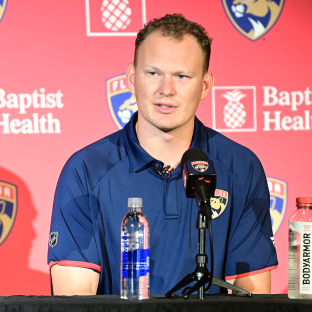


MANALAPAN, Fla. -- George Parros explained the NHL Department of Player Safety's decision-making process, giving reasons why he thinks it is working well.
Speaking at the NHL General Managers' meetings on Tuesday, the head of the Department of Player Safety also detailed the reasons for the five-game suspension it gave to Anaheim Ducks defenseman Radko Gudas for kneeing Toronto Maple Leafs center Auston Matthews on Thursday.
"We have a process in place that we feel confident in," Parros said. "We've been doing it a long time. We sweat over these decisions and pour over these decisions every night all season long. We have a process in place that's consistent and we have a team that works for me and together with me that evaluates all these plays. It's a very experienced team, veteran team, guys that have been here since the beginning of the department, not to mention all the former players that have a large set of experiences in playing NHL games, accolades.
"Some of the best guys who played the game work for this department and help make these decisions. So, our process, I feel very confident in. We've got great guys who make these decisions and I think the players should be confident in this team to do so."
Gudas was suspended for a knee-on-knee hit on Matthews that occurred at 15:43 of the second period of the Maple Leafs' 6-4 win at Scotiabank Arena.
The Maple Leafs announced the next day that Matthews sustained a grade 3 MCL tear and a quad contusion in his left leg and would miss the rest of the season.
Some Maple Leafs players and coach Craig Berube said they felt a five-game suspension was too light.
Matthews' agent, Judd Moldaver, sharply criticized the Department of Player Safety in a statement released to multiple media outlets. He also questioned why Gudas did not receive an in-person hearing, which would have allowed for a suspension of six games or longer, according to the NHL Collective Bargaining Agreement.
Gudas received a phone hearing, which limits the suspension to no more than five games, per the CBA. However, at any point during or following a phone hearing, if the Department of Player Safety determines that information collected has changed its thinking, it can offer an in-person hearing, which would permit a suspension of six games or more.
Edmonton Oilers center Connor McDavid told reporters in Edmonton he thinks it's time for the League and players to reevaluate the process the department undertakes to come to decisions on suspensions "because it seems like there's a lot of frustration there."
Parros, though, said he is "confident" in the decision to suspend Gudas for five games and in hindsight would not do anything differently because he followed the process the Department of Player Safety has used since its inception in 2011.