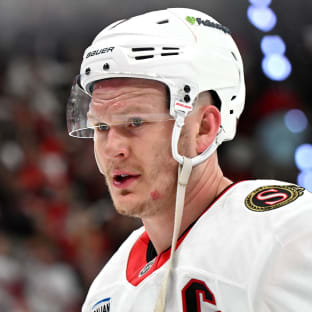

The 2025 U.S. Hockey Hall of Fame induction is Dec. 10. This year's class includes Joe Pavelski, Zach Parise, Scott Gomez, Tara Mounsey and Bruce Bennett. Here, NHL.com columnist Nicholas J. Cotsonika profiles Pavelski.
Pavelski silenced all doubters on road to U.S. Hockey Hall of Fame
Forward went from unheralded 7th-round draft pick to top offensive talent

© Brandon Magnus/NHLI
Joe Pavelski spent his entire career trying to prove himself. Now he's entering the U.S. Hockey Hall of Fame, proven to be one of the greatest Americans to play the game.
"There's never a time when you're like, 'I've done enough,'" he said. "There's always somebody better than you out there. There's always someone who's doing more, and you're just trying to compete with that.
"At the end, all of a sudden, you kind of take a deep breath and realize where you're at, and you don't fully know how you got here."
Pavelski wasn't big, strong or fast. But with a determined work ethic, he made the best of what he had: his head, hands and heart.
Selected in the seventh round (No. 205) of the 2003 NHL Draft by the San Jose Sharks, the forward played 18 NHL seasons, 13 for the Sharks (2006-19) and five for the Dallas Stars (2019-24).
Among NHL players born in the United States, he ranks seventh in games played (1,332), sixth in goals (476), 11th in assists (592) and fifth in points (1,068). He's second in games played (201), first in goals (74), tied for seventh in assists (69), and third in points (143) in the Stanley Cup Playoffs.
He reached the third round of the playoffs seven times, played in the Stanley Cup Final twice and skated in the Olympics twice, winning a silver medal in Vancouver in 2010.
"So happy for him," said Hockey Hall of Fame center Joe Thornton, a teammate in San Jose from 2006-19. "He was so good at so many things out there."
Analyzing Pavelski's sixth straight 20-goal season
Pavelski wasn't always so sure how good he was.
He said he was intimidated when he left high school in Wisconsin to play for Waterloo of the United States Hockey League in 2002-03. He struggled at first.
"I think they were even questioning, like, 'Can this kid skate?'" Pavelski said. "We were playing on Olympic (size) ice in Waterloo, Iowa, and …"
He laughed.
"It wasn't the prettiest thing."
Pavelski ended up with 69 points (36 goals, 33 assists) in 60 games that season, plus 12 points (five goals, seven assists) in seven playoff games. He led the league in goals, was named rookie of the year and got drafted, listed at 5-foot-11, 194 pounds.
He said it was probably during his second season in Waterloo when a coach tried to boost his confidence.
"I definitely had one coach at one point kind of just say, 'You realize you're a good player, right?'" Pavelski said. "And I'm like, 'I know I'm good, but these guys are probably better than me.'"
Pavelski had 52 points (21 goals, 31 assists) in 54 games in 2003-04, then 12 points (six goals, six assists) in 12 playoff games. Waterloo won the Clark Cup and he was named USA Hockey Junior Player of the Year.
When he arrived at the University of Wisconsin in 2004-05, the strength coach and his teammates pushed him in the weight room.
"You couldn't lift anything," Pavelski said. "You couldn't bench the bar. You couldn't squat two plates. You couldn't do a lot of these things. It was a quick lesson. I had to learn, 'I'm going to have to love this place if I'm going to be any good.'"
Pavelski put up 45 points (16 goals, 29 assists) in 41 games as a freshman, then 56 points (23 goals, 33 points) in 43 games as a sophomore, when Wisconsin won the NCAA championship.
"After we won that national title, there was a big feeling of like, 'I want that next step,'" Pavelski said. "'I want to see what pro hockey's about. I want to go to the rink and know that these two hours I'm fully committed trying to get better, and I can get paid doing it. Incredible. This is what I love, and I cannot worry about a whole lot else.'"
When Pavelski turned pro at 22 years old in 2006-07, he started with Worcester of the American Hockey League and was named AHL Rookie of the Month for October. He made his NHL debut Nov. 22, 2006, and scored his first NHL goal in a 6-3 win against the Los Angeles Kings. Through his first five games, he had four goals.
"You have everybody on such a high pedestal in [the NHL], that when you get there and you connect a few passes and you flip it through some guy's triangle or make a nice play behind somebody that you've watched play the last however many years, it's kind of a wild feeling of, like, 'Wow. I was pretty good out there. I can kind of do this,'" he said. "'Now, can I do this better? Or more?'"
Pavelski said he really started to believe he could do it a couple of seasons into his NHL career, but he never allowed himself to get comfortable. He kept working and learning from veterans like Thornton and forward Patrick Marleau.
"He's calculated," said Detroit Red Wings coach Todd McLellan, who coached Pavelski in San Jose from 2008-15. "He thinks things through, and he finds ways to get the most out of himself."
Pavelski became famous for going out before practice, camping in front of the net and tipping pucks from defenseman Brent Burns, making himself perhaps the best in the League at that skill.

© Ezra Shaw/Getty Images
"It wasn’t fake," said former Sharks center Logan Couture, who played with Pavelski from 2009-19. "They did that every day. It didn't matter if there was media watching or not a single person watching.
"I think with him, you got what you saw. He was real honest, humble, and that's why everyone respected him and loved playing with him."
As Pavelski grew older, the NHL became faster.
"I always felt like every year I was being tested -- if I could skate, if I had kept the little speed I had, if I was able to maintain it and play that year in the League and have success the way I had the previous year," Pavelski said. "You always have to reprove yourself, and you never take it for granted that it's just going to happen."
Pavelski was so smart and determined, though, one teammate called him the "fastest slow guy" he knew.
"I think the mental side of his game was really good, and he knew what he had to do to be successful on the ice, and he read the game well," said Marleau, who played with Pavelski from 2006-17. "He knew where the right spots were, where to go, and he was always talking with his linemates, setting up plays, doing things like that. He knew what he had to do to be successful."
Beloved by teammates and fans, Pavelski overcame injuries and scored clutch goals. The best example came in 2019.
In Game 7 of the Western Conference First Round, the Sharks trailed 3-0 in the third period when Vegas Golden Knights center Cody Eakin received a major penalty for cross-checking Pavelski. With Pavelski in the training room, the Sharks rallied with four goals on the ensuing power play and won 5-4 in overtime.
Pavelski made a dramatic return in Game 7 of the second round, scoring the first goal in a 3-2 win against the Colorado Avalanche. The fans roared at SAP Center.
"It's probably my favorite goal," Pavelski said.
When Pavelski became an unrestricted free agent after that season, the Sharks declined go three years on a contract, worried he might decline. He signed a three-year contract with the Stars on July 1, 2019.
He ended up having five more productive seasons and mentored young players. In 2021-22, his third season in Dallas, he set an NHL career high with 81 points (27 goals, 54 assists) in 82 games at age 37.
"Every time you doubt him or question what he's going to do, he responds and shoves it down your throat," said Pete DeBoer, who coached Pavelski in San Jose from 2015-19 and Dallas from 2022-24. "I've just got a tremendous amount of respect for him."
Pavelski still seems in disbelief that he will join heroes like Brett Hull, Mike Modano, Jeremy Roenick and the 1980 "Miracle on Ice" team in the U.S. Hockey Hall of Fame.
"It's amazing to kind of be welcomed into that community a little bit," he said. "What does it mean? It means that I was so lucky to play this game for a long time and have an impact, and the experiences and the life that hockey gave me is just tremendous.
"It's like the ultimate reminder of just how great this sport is and the people that you've gotten to meet and the amount of people that helped you along the way. It kind of gets you [emotionally]. It's just a very humbling experience."
NHL.com staff writer Mike Zeisberger contributed to this report