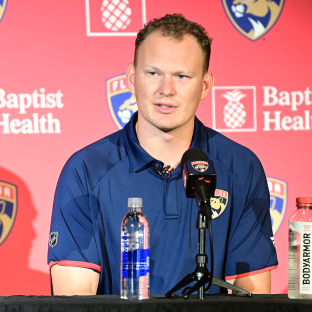

HENDERSON, Nev. -- Connor Hellebuyck spent the summer preparing to do more and to be even better in what could be the biggest season of his life.
The Winnipeg Jets goalie will be defending the Hart Trophy as NHL most valuable player. He will be defending the Vezina Trophy as the League's top goalie. He won each last season, going 47-12-3 with a 2.00 goals-against average, .925 save percentage and eight shutouts, becoming the first goalie to pull off that feat since Carey Price in 2014-15.
Hellebuyck will again be the backbone of the Jets, who won the Presidents' Trophy last season as the team with the best regular-season record before being eliminated in the Western Conference Second Round. They're among the favorites again in the West and remain a legitimate Stanley Cup contender.
On top of all of that, Hellebuyck also has the chance to be the United States' No. 1 goalie at the Olympic Winter Games Milano Cortina 2026 and an opportunity to help the Americans win gold for the first time since the "Miracle on Ice" in 1980.
Hellebuyck spoke about everything up for grabs for him this season along with his beliefs as a No. 1 goalie and his process to maintain his status during an interview with NHL.com at the NHL/NHLPA North American Player Media Tour Wednesday.
When you have a season like you had last year, rolling through it the way you did, where do your thoughts go in the summer as you're training and you're thinking about getting back to Winnipeg?
"I was thinking, 'How can we take that to another level? How can we continue to build?' Just because you had success doesn't mean you're going to have success every single day. So how can we continue to build that? That's what I love about the game and playing the game, is there's always more to learn. There's always adapting with the game and how the game is changing. So, for me, it was what's the next step. I believe it's managing stress levels. Near the end of the season when you get into the playoffs, the stress is just immediately higher. Everyone is staring at you and trying to point out your wrongs. It comes down to really just getting yourself in your bubble, playing your game, worrying about what you want to do and what you like to see."
Can you work on that or is that just a mental thing?
"It's a mental thing but you can work on it in practice. Say the practice isn't going perfectly, instead of getting all stressed out about it and bent out about it, just give yourself a chance to think about it and adjust the things you want to adjust and continue on just playing instead of letting that build up there and frustrate you."
Is that the difference for goalies between playoff hockey and regular season hockey, the stress level of it? Is the stress level the biggest difference?
"I would say probably, yeah. That and the playoff game is so team oriented. There's never one guy that's going to get you through it. If there's one guy that's having a really good playoffs, well I can promise you that there's 19 other guys that are contributing to his success. The thing I've learned is, no one guy should be blamed and no one guy should be put on a pedestal. You need everybody."
Are you able to put yourself in your own bubble during the playoffs or is it harder to do?
"Yeah, I'm definitely able to. I mean, it doesn't matter if you lose by one goal or you lose by 10 goals, at the end of the day, it's a loss. You've got to move on and win the next one. Stats really just fly out the window. You don't have to care about stats. Stats are important for contracts and the business side of things, but when the playoffs come around you don't really care about that. It's did you win or did you lose."
When you were rolling in the regular season last year, what were you feeling? Describe your emotion, your preparation. How did you keep it going?
"Well, I managed my rollercoaster really well last year. That being said, the team was playing great last year. They were scoring goals. They were keeping chances down. It made my life a lot easier and made the game predictable, and that's one of my strengths. So they played right into my strengths. But for me personally I managed the rollercoaster. Any time something bad would happen, I was immediately throwing it away and not worrying about it. I wasn't giving it a second thought. Same old process of watching video and sometimes when you're doing really well you say, 'OK, let's bank this video for later,' so when you do start to come down you can go back and watch it and remember, 'OK, things are good.' So, the whole management side of things, that's really important. But when I was in the mix of it, it was just another game. I would always tell (backup goalie) Eric (Comrie), we had a bunch of little, I wouldn't say superstitions but routines that we love and just crack us up that just kept the game light. We were like kids again having fun. It's so important not to overthink it, just go out there and have fun."
This year could be a huge year for you with all you can accomplish with the Jets, aiming to be the United States' No. 1 goalie at the Olympics, defending the Hart and Vezina, trying to deliver in the playoffs. What do you think about what this year and the potential of this season could be for you?
"For me I'm kind of going into it as just another season, just another season. We're continuing to build, but I don't want to bring expectations into it. I think expectations kill. I've seen it enough. We're a good team but sometimes you don't win when you expect to win, and you win when you don't expect to win. Really just trying to keep all expectations off the table and go in with a fresh slate. We're going to build our game the way we ended last year, put our best foot forward and let everything fall into place."