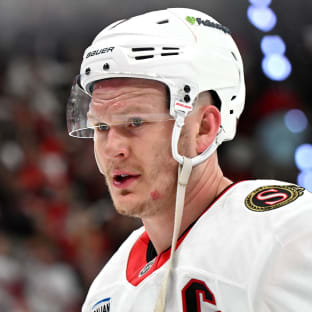
Mammoth general manager Bill Armstrong has a simple way of tracking the growth of Keller, who was selected by the Arizona Coyotes with the No. 7 pick in the 2016 NHL Draft.
"When I came in (in 2020) he was an NHL player, but he was a boy," Armstrong said. "Now, he's an NHL player and he's our captain and he's a man."
Keller is 27 and six games into his second season as Utah's captain.
Utah (4-2-0) has won three in a row and is undefeated at home, including a 3-2 win against the Boston Bruins on Sunday. Keller has six points (two goals, four assists) in the past two games. He had an NHL-high 90 points (30 goals, 60 assists) in 81 games last season, when Utah finished sixth in the Central Division, missing the playoffs by seven points while building hope in a new and charged-up market.
"I don't think that's the ceiling for me," Keller said.
It can't be.
Keller said missing the playoffs this season will not be acceptable, not after a year of getting comfortable in a new market after the franchise was established in Utah -- the Coyotes’ assets acquired by Smith Entertainment Group in April 2024 -- and certainly not after the amount of dollars Mammoth owners Ryan and Ashley Smith have invested into a state-of-the-art training facility and a still-ongoing renovation of Delta Center.
"We've talked about how we expect to win," Keller said. "They've given us everything that we need to have success and have no distractions. It's great to have those expectations. That's what we want."
The chance to win is why Keller went to the World Championship last season. He had 10 points (three goals, seven assists) in 10 games and was Team USA's captain. The U.S. won the tournament, which coincides with the Stanley Cup Playoffs, for the first time since 1933.
"Years prior I had some injuries and I wasn't able to go, and this time I had never been healthier after a season," Keller said. "I felt great. I had some buddies that were going. Me and (Nashville Predators defenseman) Brady Skjei talked about it. We played against each other the last game of the season and we were like, 'We're going there, let's win.' It's definitely cool to win. First one in 92 years, that's pretty cool."
His performance mattered more than just helping make history for USA Hockey.
Keller was not on Team USA's roster for the 4 Nations Face-Off this past February. But going to the Worlds, winning there and playing well raised his stock to represent his country in the Olympics this coming February. He was one of the 40 players invited to U.S. Olympic Orientation Camp in Plymouth, Michigan this past August.
"That's for them to decide, but we had such a great team of players, coaches and everything came together (at the World Championship)," Keller said. "I think we were a really unselfish team and that's why we were able to do. It was just a great experience and it's cool to do something that hasn't been done in 92 years even if it's maybe not all the best competition from all the countries. But it's a very hard tournament to win. You play in meaningful games, games with pressure on you."
That has been missing in Keller's NHL career. The only time he's been to the postseason was in 2020, when the Coyotes returned from the pause for the coronavirus pandemic as the 11th seed in the Western Conference. Twelve teams returned to play in the postseason in each conference.
The Coyotes defeated the Predators 3-1 in the best-of-5 Qualifying Round, but lost the best-of-7 First Round to the Avalanche. He had seven points (four goals, three assists) in seven games.
Before this year, Keller hadn't played internationally since the 2019 World Championship, when he had four points in eight games and the United States finished seventh.
Keller, who has 515 points (198 goals, 317 assists) in 607-regular-season games with the Coyotes and Utah, was hopeful that he would get a chance to play in the 4 Nations Face-Off, but that did not happen. That might have been the inspiration he needed to find an extra gear to finish last season strong and impress at Worlds too.
"It (stunk), but I wasn't going to let it keep me down the rest of the year," Keller said. "I think after that I played my best hockey of the season. I was super motivated after that and wanted to maybe show them they made a mistake. I think it helped me out. Not making teams can in the long run be better for you sometimes. I definitely used it as motivation and it worked."