
Clark_Ovechkin

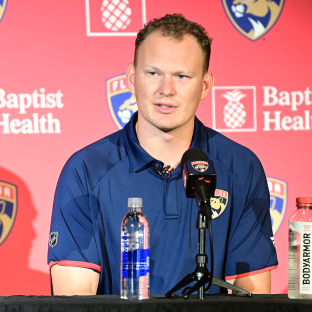
Chris Clark was talking to his children last week about the possible symmetry he might witness when Alex Ovechkin and the Washington Capitals visit the Columbus Blue Jackets for each team's regular-season finale on Tuesday (7 p.m. ET; MNMT, ESPN).

A former forward who played 11 seasons in the NHL, Clark was a healthy scratch for the Capitals and watched from the stands when Ovechkin scored twice in his NHL debut against the Blue Jackets in Washington on Oct. 5, 2005. Now an assistant GM for Columbus, he will be in the stands again Tuesday when Ovechkin, the NHL's all-time leader with 929 goals, plays what could be the latter's final NHL game.

"Just like his first one, if it ends up being his last game, I'll watch that from the stands," Clark said. "I was actually talking to my kids about that and just thinking. I was like, 'Oh yeah, if this is his last game, he started with two goals, his first game ever, and then we'll see what happens if this is his last game.'

"So, it'll be pretty neat."

In his 21st NHL season and the last of a five-year, $47.5 million contract ($9.5 million average annual value), Ovechkin said last week he will wait until the offseason to decide if he will return next season. The 40-year-old left wing insisted again after a 3-0 victory against the Pittsburgh Penguins in the Capitals' final regular-season home game on Sunday that he hasn't decided on his future.

With that in mind, even though the Capitals (42-30-9) and Blue Jackets (40-29-12) were eliminated from Stanley Cup Playoff contention after the Philadelphia Flyers defeated the Carolina Hurricanes 3-2 in a shootout on Monday, Clark acknowledged that the possibility it could be Ovechkin's final game will be a storyline that everyone at Nationwide Arena in Columbus will be thinking about.

PHI@WSH: Ovechkin buries loose puck, earns twentieth 30-goal season

"It's a sports town and people realize that, whether they're true, No. 1 hockey fans or they're just there to watch games," Clark said. "But I think everybody recognizes what could be for sure."

Clark had a front-row seat for the first four-and-a-half seasons of Ovechkin's legendary career and preceded him as Capitals captain, wearing the "C" from the start of the 2006-07 season until his trade to the Blue Jackets on Dec. 28, 2009. Clark was acquired by Washington in a trade with the Calgary Flames on Aug. 4, 2005, so he and Ovechkin were new to the team when training camp began about a month later.

But Clark didn't know he was meeting the player who would go on to break the NHL goals record and also set League records for 30-goal seasons (20) and 40-goal seasons (14) and tie the record for 50-goal seasons (nine). It was clear quickly, though, this kid from Moscow, who was the No. 1 pick in the 2004 NHL Draft, wasn't just another rookie.

"Everybody knew there was something special about him, but who can predict the longevity and being able to do what he did every year?" Clark said. "It's tough to do it once, twice, but now everybody in the League for the last (21) years knows what he's going to do and knows what type of player he is, knows when he's on the ice every time.

"And he's still able to put up numbers like he does, which is just crazy."

Even at 40 years old, Ovechkin leads the Capitals in goals (32) and points (63) and is one of three players on the team, along with forwards Anthony Beauvillier and Brandon Duhaime, in line to complete the full slate of 82 regular-season games. It would be the sixth time in his career Ovechkin didn't miss a game.

Ovechkin, who captained Washington to its first and only Stanley Cup championship in 2018, often credits Clark among those who showed him the way during his first few seasons in the NHL.

"A hard-working guy, a great leader," Ovechkin said. "I learned a lot from him. He played physical, blocking shots, fights, all that kind of stuff."

Clark was moved to Ovechkin's line midway through the 2005-06 season and had his two most productive NHL seasons playing alongside him and Dainius Zubrus. He had 39 points (20 goals, 19 assists) in 78 games in 2005-06, when Ovechkin led the Capitals with 52 goals, 54 assists and 106 points and won the Calder Trophy as the NHL's top rookie.

Clark followed that up by setting NHL career-highs with 30 goals, 24 assists and 54 points in 74 games in 2006-07. Ovechkin led Washington that season, too, with 46 goals, 46 assists and 92 points.

"He could change the game in an instant," Clark said. "On a rush up the ice, early on he was beating the defenseman wide because they didn't realize how fast he was. When they figured that out towards the end of (his rookie season), then they would just back up and let him shoot through the screen. 

"And then it was the goalie's fault, not the defenseman's fault after that."

Clark was named captain to succeed Jeff Halpern after the latter left Washington to sign with the Dallas Stars following the 2005-06 season. He knew well before his trade to Columbus, though, it was only a matter of time before the role was handed over to Ovechkin.

"I knew eventually as we went along, 100 percent, because he was the best player in the League and best player on the team, obviously, and he was the face of the franchise," Clark said. "So, you knew it was going to be. He was going to get it and he grew into it too.  He grew into that role where he cared about the players, he cared about the team, he cared about winning over himself. And he did that from Day 1."

Clark remembers being excited for Ovechkin's first game like everyone else in the organization. He sustained an injury during training camp, however, and, though he was healthy in time for the season opener, coach Glen Hanlon decided not to play Clark in that game. 

But Clark saw Ovechkin put on a show. After setting the tone on his first shift with a big hit on defenseman Radoslav Suchy that knocked loose a pane of glass behind the Blue Jackets net, he scored twice in the second period to erase two one-goal deficits and spark the Capitals to a 3-2 victory.

"I remember the two goals," Clark said. "I remember I didn't even know where the press box was at the time, so I watched a couple periods from the stands and in the weight room before that. … He didn't take a shift off, and that's probably one of the most special things about him. 

"He didn't take anything for granted either. And I don't think he does now either."

Related Content